The Islands
The Islands
Travelers typically think of Greece as the Mediterranean’s island nation, but in fact, Italy has hundreds of islands as well— from the usual suspects, Sicily and Sardinia, to the 120 islands in the Venetian lagoon. Some are absolutely enormous—Sicily and Sardinia are the first and second largest islands in the Mediterranean, respectively, and each has dozens of dialects and subcultures within it. But there are also small islands like Pantelleria and Salina, which are governed by Sicily, and Sant’Antioco and La Maddalena, which are part of Sardinia. Then there are the Neapolitan, Pontine, and Tuscan archipelagos, which rise in the Tyrrhenian Sea off the western coast of mainland Italy, and the Tremiti chain in the Adriatic Sea off the coast of Puglia. The islands of the Venetian lagoon vary in size from less than an acre to the larger clusters connected by bridges that comprise the city of Venice. (To be honest, the lagoon merits a hundred books of its own—hmm . . . maybe my next project?—but in these pages you’ll find some of my favorite recipes from the lagoon’s islands, including a few for an epic aperitivo spread, as well as descriptions of beloved places in the lagoon like the farms of Sant’Erasmo.) I touch on most Italian island cultures in this book, either with recipes or features, but a full account of each would occupy dozens of volumes.
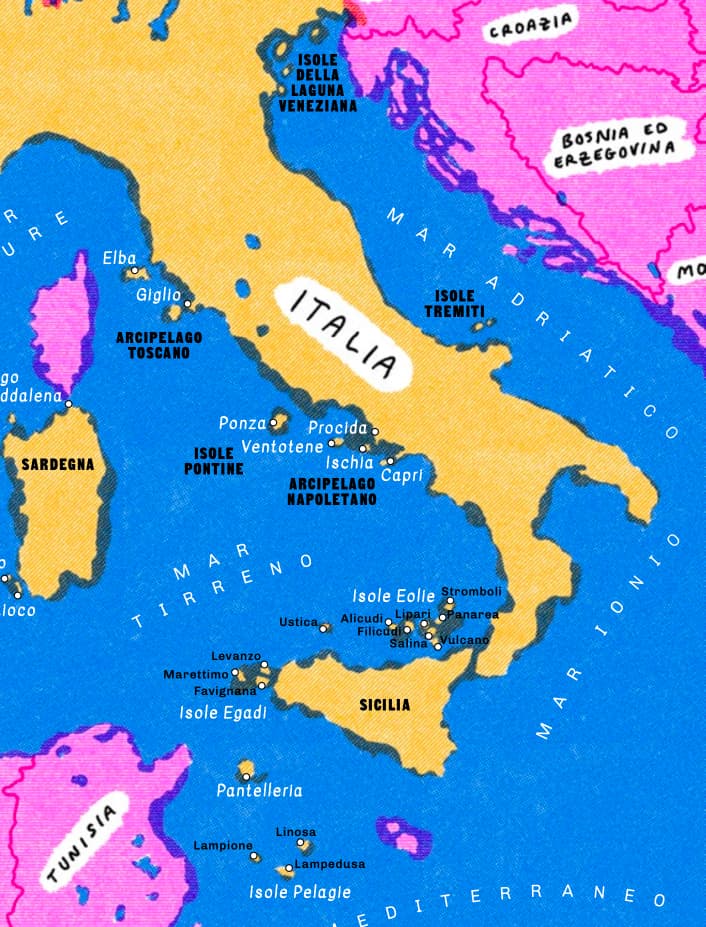
The map of the islands below will give you a sense of their location, not just in relation to one another, but also to North Africa, France, and the Balkans. Italy’s unification in the mid-nineteenth century brought dozens of island cultures under a single governing body for the first time since the fall of the Roman Empire. But the impact of modern Italy’s 150 years of collective rule pale in comparison to that of the fallen kingdoms that spanned the Mediterranean in previous ages, shaping the islands’ cultures, languages, customs, and foods. Due to their strategic locations between continents and along trade routes, the islands now governed under the flag of Italy were home to some of Europe’s most ancient recorded civilizations dating back to the Iron Age, and were historically ripe for conquest and trade. The islands, as a result, reflect a confluence of Arab, Spanish, French, Mesoamerican, Mediterranean, and Italian ingredients and cooking techniques, and many of their cuisines developed on parallel tracks to one another. But let’s get a sense of the islands themselves before we dig into the recipes.
Sardinia
And its smaller islands
I’m starting with Sardinia here, not because it comes before Sicily alphabetically, but because I want it to be the destination of your next Italian holiday. Naturally, I think all the islands should be a priority, but realistically, you have to choose one as a starting point, and this should be it. It’s wild. The island lies about 150 miles off Italy’s west coast, just opposite the mainland regions of Campania and Calabria. Corsica is a short ferry ride to the north, while Tunisia is due south. Sicily, which is just a bit larger than Sardinia, is about 200 miles southeast and is home to around 3.5 times the number of inhabitants.
Sardinia was one of the earliest places in Europe to be settled and has historical ruins dating back more than ten thousand years. Things really started to get going among local tribes in the Stone Age, circa 3200 BCE, and by 2000 BCE, settlers had arrived from mainland Europe. The Nuragic culture, the island’s most important native community, survived until the third century BCE. The vestiges of this ancient society are still present all over Sardinia, mainly in the form of nuraghe, fortified stone complexes that rise from fields and perch on hills all across the island.
By the seventh and sixth centuries BCE, things started heating up in the Mediterranean. The Greeks and Carthaginians were on the move and in competition with each other. When you consider Sardinia’s dominant position between North Africa and the European continent, it’s logical that the Carthaginians would establish colonies there. The evidence for their vast trade network is still preserved at sites like Tharros on the Sinis peninsula. The still thriving bottarga (cured gray mullet roe) tradition of the area testifies to the enduring influence of Carthage.
The Romans took over in 238 BCE (though they were unable to completely eradicate the stubborn Nuragic culture, especially in the Barbagia sub-region, which still boasts a reputation for defiance) and reigned over the island for seven centuries. The island was attacked and conquered in the Middle Ages by waves of invaders, including the Vandals, Byzantines, and Arabs. But it asserted self- rule by four kingdoms until the fourteenth century, when Spain’s Aragon rulers began to exert influence amid attacks from the maritime republics of Genoa and Pisa.
Throughout its millennia of civilization, Sardinia has maintained a strong rural character, and does so to this day. There are twice as many sheep (three million!) as people on the island, and about one-third of all of Italy’s sheep reside there. Their main product is pecorino (sheep’s-milk cheese), which takes countless forms. The best known are Pecorino Romano (in spite of its name, almost all of it is made in Sardinia, not near Rome) and Pecorino Sardo, salted cheeses with a sharp, piquant flavor. There are other wonderful cheeses, too, like Casizolu and Fiore Sardo. Since antiquity, durum wheat has been an important product and is responsible for the forms and flavors of Sardinia’s intricate pasta shapes like and ornamental breads.
Sicily
And its smaller islands
Sicily isn’t quite as historic as Sardinia, having only been settled around 8000 BCE. From that point on, civilization advanced slowly until Carthage began launching expeditions from North Africa, establishing colonies in western Sicily around 850 BCE. A century later, Greek settlers landed in the eastern part of the island and developed their own important settlements at Syracuse and Gela. Greek expansion on the island brought Sicily into Hellenic culture’s own identity. The Greeks built temples, too, including the spectacular sanctuaries at Agrigento and Selinunte.
Tension between the Carthaginians and Romans flared up in the third century BCE, and the outcome of the resulting Punic Wars was Roman supremacy. The Romans relied on Sicily for its grain, grapes, and oil during their seven- hundred-year reign there. When the Western Roman Empire collapsed, a series of wars for the island followed. Vandals and Goths vied for power and ultimately the Eastern Roman Empire (aka the Byzantine Empire) took control of the island until the ninth century. Byzantine rule was challenged by Arab armies led by the emir of Tunisia beginning in 827, and after nearly a century of warfare, most of the island came under Arab rule. The period coincided with a golden age of technology, economics, agriculture, and philosophy in the Arab world. Land reforms and improved irrigation massively improved Sicily’s productivity and transformed arid deserts into lush gardens and citrus groves; the advancements are visible even today. Thousand- year-old qanats (irrigation canals) continue to supply Palermo’s suburbs with water.
The period of Arab rule was an impactful one in the culinary sense. Not only did new farming practices improve crop yields, but they also changed what could be grown on the island. Eggplant and sugarcane arrived for the first time, while citrus, almonds, and pistachios flourished in a way they never had before. Palermo (then known by its Arabic name, Balarm) became one of the most sophisticated cities on Earth, and following the expulsion of the Arab settlers by Norman invaders in the eleventh century, the island’s culture and cuisine continued to flourish as the Normans built on their predecessors’ successes.
The beginning of the Spanish period in the fourteenth century was a prosperous one, and ultimately peaked in the seventeenth and eighteenth centuries, when nobility embellished Sicilian churches and cities with funds from colonial plundering and introduced new ingredients from Spain’s Mesoamerican conquests. During this period, tomatoes, potatoes, prickly pears, squashes, beans, and chocolate arrived and enriched the local gastronomic culture. The wealth and stability didn’t last, though. The stunning novel Il Gattopardo (The Leopard) by Giuseppe Tomasi di Lampedusa perfectly traces the late-nineteenth-century decline of the island and its wealthy patron class in the time just before and after Sicily fell to Italian unification.
Le Isole Pontine
The Pontine Islands, off the coast of Lazio, were resettled in modern times by Spanish Bourbon aristocracy and Neapolitan peasants, which is why their dialect and cuisines are so closely related to Naples. They share a somewhat common history with Ischia and Procida, farther south. The diets are rich in brothy soups likepesce all’acqua pazza and zuppa di cicerchie . Ventotene’s lentil soup is nearly identical to that of Linosa—an example of two distant rural island cultures on opposite sides of Italy coincidentally mirroring one another.
Ponza
Arrivals to Ponza from Anzio skirt the island’s eastern coast, where sheer tufa cliffs bleached white by the sun are a preview of the dramatic vertical volcanic walls that partly define Ponza’s topography. Ponza is best appreciated from the water— boat rentals in the port are a convenient and affordable way to explore the island and offer spectacular views, not to mention access to coves and bays not accessible by land.
The port is the largest village on the island; its pastel buildings follow the volcanic peaks of the area. As the closest island to the Italian capital, Ponza is popular with Romans. As such, it’s crowded on summer weekends and during the high season of July and August, but during the rest of the year, it’s sleepy and downright magical.
Today’s Romans were not the first to discover Ponza. In antiquity, it was a place of exile as well as voluntary retreat. Aristocrats built villas on the island, and according to legend, carved saltwater swimming pools into the soft rock faces, for bathing without the risk of sunstroke or suntan. Later these caves were used to raise eels, still an island delicacy. But after the fall of the empire, the island fell into a period of neglect, and it wasn’t inhabited again until the 1730s, when Charles III of Spain founded the village that now accepts ferry arrivals. A few decades later, Le Forna on the north side of the island was founded by inhabitants of Torre del Greco, a town on the Bay of Naples.
Ventotene
Once a fishing and farming village, Ventotene is now a sleepy island with just a small year-round population. It’s famous for its dried legumes, especially lentils, once a major export that has seen a decline in production due to an economy that has shifted away from agriculture toward tourism.
L’Arcipelago Napoletano
The three main islands in the Bay of Naples— Capri, Ischia, and Procida—have a robust relationship with the mainland, so their cuisines share a lot in common with the Amalfi Coast and Naples and are particularly rich in seafood. This is in contrast to other islands, where risk of invasion meant harvesting seafood was dangerous and mostly avoided. But the arcipelago napoletano has been an established tourist destinations for centuries (as opposed to the other small islands, which only saw a tourism boom beginning between the 1960s and 1980s).
Capri
Close your eyes. What’s the first Italian island that comes to mind? I’d put my euros on Capri (pronounced CAH-pree). It’s home to Italy’s most famous salad (insalata caprese with mozzarella, tomato, and basil) and a delectable flourless chocolate cake, torta caprese. This tiny island in the Bay of Naples was developed in the nineteenth century for foreign travelers, mainly well-heeled tourists from America and Northern Europe. For well over a century, it has drawn tourists to its famous sea cave, the Blue Grotto, luxury shopping, and lemon tree–dotted coastline. In 2019, Capri drew 2 million tourists to its 4 square miles. Compare that to 9 million to Rome’s 500 square miles, and you can imagine how absolutely unpleasant Capri can be in high season unless you can retreat to a private beach club or your boat to enjoy the island away from the crowds.
Ischia
From afar, this ancient island looks like a green volcano rising from the sea. And in a way, it is, though the volcano is barely active, merely emitting heat from springs that warm coves around the southern part of the island. For a couple thousand years, islanders have been eating coniglio all’ischitana while farming the fertile, terraced terrain of their verdant island.
Procida
My aversion to fancy things is almost as intense as my attraction to that which is unpolished. It is both of these factors that draw me to Procida again and again. As a bonus, the food is better than Capri and Ischia, too. The place feels like a little slice of Naples has broken off and floated into the bay. The chaotic, soulful, and colorful place had so much in common with the nearby mainland, much more than with its island neighbor, Ischia. Procida’s port is loud and raucous, with backfiring scooters and old women shouting from windows. Above the port, the rest of the island’s settlements are a mix of apartment blocks and modest villas surrounded by citrus groves and other fruit trees.
Le Isole Tremiti
Lying about 12 miles off the coast of Puglia’s Gargano Peninsula, the Tremiti archipelago is composed of five islands: San Domino, San Nicola, Capraia, Cretaccio, and Pianosa. Only the first two are inhabited. Due to their tiny year-round population and reliance on tourism, there’s not a huge litany of local dishes, and you’re more likely to find generic seafood specialties like spaghetti with clams or fried calamari. There are a few bread soups on the island that speak to just how frugal the islanders were, never letting even stale bread go to waste.
La Laguna Veneziana
The part of the Venetian lagoon that most visitors encounter is Venice, a cluster of islands connected by bridges spanning its many canals and linked to mainland Italy by a causeway. This is also where most visitors eat, standing at the counters of the city’s bacari (local taverns) serving cicchetti (small bites) like whipped salt cod on polenta or sweet-and- sour sardines. There’s a strong grazing culture in Venice, and you’ll find locals sipping Select spritzes, cold beer, or quaffable still and sparkling white wines at all hours of the day, perched at counters gossiping in the impenetrable dialect. There’s plenty of seated dining, too, and unsurprisingly, lagoon fish and catch from the nearby Adriatic Sea abound. Unlike on the other Italian islands, polenta is far more prevalent than pasta, though one of the city’s signature pasta dishes, bigoli in salsa, did end up on the cover of this book! There’s lots of fabulous produce, too, and much of it comes from the so-calledterraferma (the mainland; terraferma in Venetian dialect, which shuns double consonants!), like the farms of Treviso and Chioggia, especially all the incredible winter radicchios.
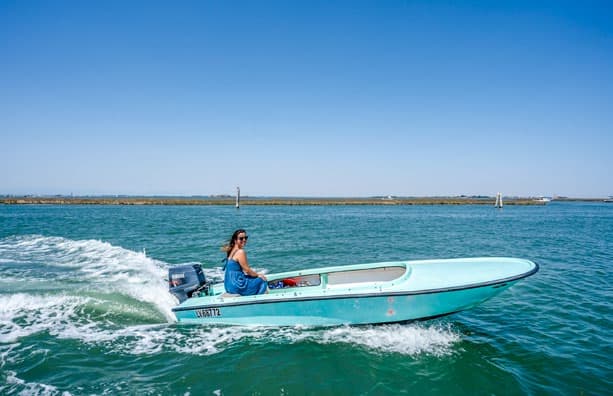
Beyond Venice itself, the other lagoon islands each have their own character, and some are downright rural. The island of Sant’Erasmo is teeming with farms and does its part to feed the city, producing highly prized artichokes in the winter and a year-round bounty of fruits and vegetables. The northern and southern lagoon and Pellestrina boast small- scale fisheries. If you arrive by air, look for the trabocchi, cantilevered nets used to catch local fish, protruding from wooden huts on stilts. Or even better, hire a boat to take you around the lagoon and its islands for a full immersion in the ecology and cuisine of Venice (if we’re friends, I’ll take you around in Laura, otherwise contact Classic Boats Venice located in La Certosa).